45403
miles
24
countries
2
years
1
incredible plane
The Starship Diaries details the trip of a lifetime, brimming with adventure, discovery and fascinating insights into flight and the world around us.

45403
miles
24
countries
2
years
1
incredible plane
Join the adventures of a Silicon Valley salaryman whose good fortune put him in the pilot’s seat of a high-tech Beech Starship, one of a dwindling number in the world. He set out on what many only dream of: slowly meandering around the planet with no fixed route, and no fixed return date.
Discover new countries and cultures. Find out how the terrorist attacks of September 11th, 2001 changed aviation and the world’s perception of America. And learn about the science, art and challenges of flying a high tech business jet-class plane around the world.
Running out of fuel over the Pacific. Shot at over Africa. Near-misses with other aircraft.
Playing music in an Indonesian bar. A month-long illness. Stories of exploration and revelation.
Extensive detail of places visited. Historic, economic, social and other info.
How the attacks of Sept. 2001 midway through the trip changed the flight, and the world.
Insight into the science of flight for non-pilots. Acronyms defined. Mysteries explained.
A memorial of sorts to the aircraft at the heart of the story, mothballed because of economics.
Vicariously share round-the-world adventures in this delicious flight of fancy — a travelogue that incorporates superb musings on the beauty of flight and the mystery of the world around us. The science of flight is explained in 150+ technical footnotes and the route of travel is detailed on 38 maps. A standout contribution to aviation and travel literature.
Published by 11010011, California. Copyright © 2004 by Dallas Kachan. Beechcraft, Starship and the Starship image are properties of Raytheon Aircraft Corporation and are used here by permission. Other trade names referenced are properties of their respective holders. Other copyrighted works referenced by brief quotations are the property of their respective holders. All rights, including the right to reproduce this book or portions thereof, are reserved under international and pan-American copyright conventions. This book is a work of fiction that references real-world places, people and events. ISBN 0-7795-0074-1. Printed in Canada.
At the heart of The Starship Diaries is the Beechcraft Starship – a radical new design in corporate aviation. Only fifty-three of these beautiful machines were produced. For a variety of unfortunate reasons, only a handful are still flying.


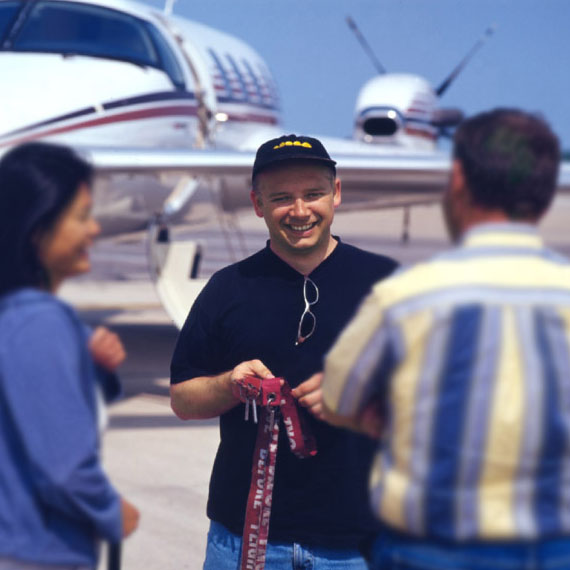


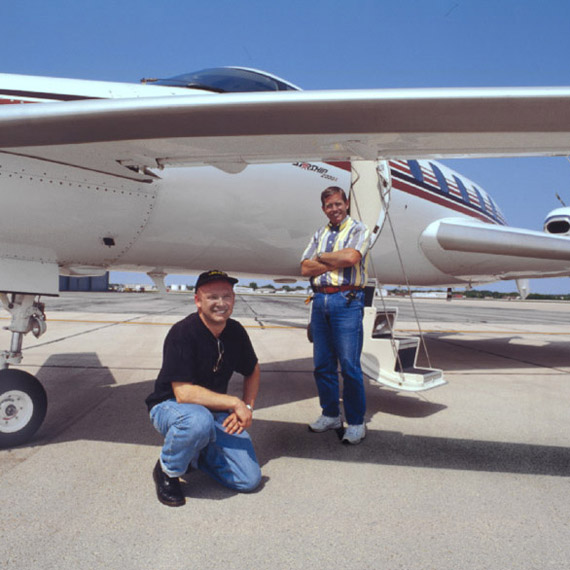

A great travel adventure even for those without an aviation background.

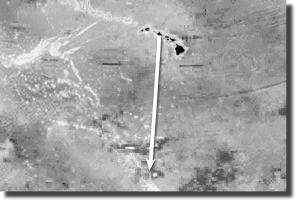
Date: January 3rd, 2001
Departure: Lihue, USA (PHLI)
Arrival: Palmyra, Kiribati (PLPA)
Distance: 978 nm
In nautical lore, Palmyra is a place almost as famous as the Bermuda Triangle, though its infamy is relatively recent. It’s a mysterious place, not terribly large, only 12 kilometers square, or about 20 times the size of the National Mall in Washington, D.C.
Palmyra isn’t really an island—it’s an atoll, or a former volcano-like structure that rose thousands of years ago from the sea floor to ultimately end up as a ring of coral reefs. Hundreds of atolls dot the Pacific. Maybe the most famous of them is the Bikini atoll, where the U.S. Navy tested nuclear weapons in the 1950s. Nearby are the legendary deep trenches of the Pacific: the Mariana and Tonga abysses, incredibly some seven miles deep and epicenters of many earthquakes. The trenches also parallel strings of volcanic activity in the Pacific.
Palmyra is technically made up of about 20 tiny islets covered with dense vegetation. Coconut and balsa-like trees on Palmyra grow up to 30 meters, although at no point does the actual land rise much more than two meters or so above sea level. The area is equatorial, hot and very rainy. It’s located within the boundaries of the remote Oceanic Republic of Kiribati (correctly pronounced kiri-BASS’; the local language doesn’t have an “s,” so “ti” is used to represent the “s” sound.) The area is so remote that it’s not served by any major airline. Kiribati was previously known as the Gilbert Islands, although it’s been independent since 1979.
In pictures, Palmyra looks like an archetypal deserted Pacific island paradise, in the vein of Gilligan’s Island. But for one of the world’s most desolate, isolated places, it’s been a stage for surprising amounts of drama and intrigue.
Palmyra was a U.S. air base during World War II, and much of the single road over its diminutive area was built during this time. It was, until recently, incorporated territory of the U.S., and administered from Washington by the U.S. Department of the Interior. A non-profit group called the Nature Conservancy bought the atoll in 2000 to research and try to restore ecological balance to the area. The group has a small contingent of scientists and caretakers on Palmyra, and has kept a World War II-era runway on one of the largest islands serviceable to bring in supplies. The conservancy keeps fuel there, but not much. The researchers on Palmyra were connected to the mainland via a satellite phone hookup, so I learned all I could about the history of the area and the work the conservancy was doing there, and called them to plead my case. The first few calls went unanswered, no voicemail. However, on the misty Hawaiian morning of the 2nd of January, the phone was picked up on the first ring.
“Hello?”
“Uh, hi there. May I speak with Beth?”
“This is she. Who is this?” The sound of thunder and rain hammering against thin glass windows raged in the background.
I introduced myself and explained the chain of people and relationships that had led me to her. I was nervous. An awful lot hung on this particular call. Beth, the senior researcher on the island, had the authority to shut down this little plan. Nerves were all the more frayed by the awkward satellite delay between the two of us, and static on our connection.
I eventually came clean. “Beth, I’m trying to get to Fiji, and beyond, actually. I’m flying a plane that has pretty good range, but I need to refuel somewhere on route. Palmyra would be a perfect stop for where I’m trying to go. I’ve read a lot about what you folks have been doing there and am impressed. Can I get your permission to land and refuel? I’ll be out of your hair before you know it, and will pay you a very fair price for the fuel.”
A pause. “I see,” she said. Another pause. Thunder rolled in the background over our tenuous connection. “With all due respect,” she began, sounding tired, “do you have any idea how many people ask us to do this? I’m sorry, I don’t mean to sound rude, but we’re not running an airport, here. We’re researchers. This is a private island. We don’t have the time or the ability to refuel any old Joe. We barely have enough fuel on hand for our own supply runs. I’m afraid you’re going to have to find another option. I’m sorry.” She was trying to be as friendly as she could, but was definitive.
I couldn’t let her hang up. I needed to keep her on the line a little longer.
“I understand. I’m sure you get requests like this all the time. I appreciate that you’re busy and have limited resources. So Gabby here at the office on Kauai suggested a special arrangement. I’ve got a fair amount of space for cargo, so how about I pack the stuff the office here has got for you, take orders for whatever else you might need right now and bring it on down to you? Think of me as a bonus cargo flight. And I’ll still pay you well for the fuel. It’s a double-positive for you and the conservancy—you get your stuff a few weeks sooner, and you end up ahead dollar-wise.”
Gabby had told me Beth and her team had been eagerly awaiting the results of some spectroscopy analyses they’d sent to labs in Hawaii a few weeks earlier, were looking forward to their mail and were running especially low on certain items like contact lens solution and disinfectant—and the latter was absolutely necessary in equatorial climates. I was hoping this would improve my case.
“Thanks,” she said. “We could really use some stuff in particular, actually.” She reflected a moment. “We appreciate it, but again, I don’t think we can really spare the fuel. It’s incredibly expensive to have it brought out here, as I’m sure you understand. We don’t have much left, and the next tanker doesn’t come until next month. I’m sorry.”
Damn. But I still had a trump card.
“I see. I understand. One last question: Gabby here tells me you guys occasionally accommodate large foundation contributors for visits. Any room for one more?”
“You’re a patron?”
“Not yet. But I can be. A small contribution to the conservancy that, say, would pay for your fuel for the next six months. I’ll work it out with Gabby.”
A longer than awkward pause. “I see there’s no dissuading you.” She covered the phone with her hand and had a short conversation with someone. Her muffled voice didn’t sound overly perturbed, just a little ruffled. “Have Gabby call me. I guess the guest house can be ready tomorrow,” she came back on and said. “But don’t expect much. We don’t exactly have, like, services here.”
We worked out details. Weather permitting, the next day would be flight day. I checked in with Gabby, made preparations, grabbed what needed to be transported to Palmyra and wrote the conservancy a generous—and tax-deductible—check.
The next day dawned cloudless. There was no sleep to be had after the sun came up, so a quick barefoot run on the beach in front of the hotel started the day. My feet were awash in the lapping morning waves. They looked stark, alien against the dark sand. The black rock, ground into nothingness by the incessant waves, belied the island’s volcanic origins. Gentle morning light gave the mountains an earthy glow. The whole island morning was rich with color.
The run helped calm my nerves and dull the twitchy tingle in my spine. Today’s flight meant leaving the comfort of U.S. airspace, and the relative comfort of western life. As much as one might disparage the trappings of Americana, they’re predictable and reassuring—which is, of course, their allure. I was about to stray far off the beaten path. It was the first real dangerous stride in this journey, master of my own providence.
A taxi to the airport found the Starship, fresh and fueled. The morning pre-flight prep in the pilot’s lounge was fairly involved. The weather and winds were double-checked, a flight plan filed and account settled up. Paying by credit card, there was the anxious realization that there weren’t bound to be many places soon where payment could be easily made with plastic. This is why I’d made the decision to carry cash, lots of it, in the American dollars coveted overtly or surreptitiously around the world.
A famous Hollywood actor was waiting in the lobby of the FBO for his driver. We chatted a few minutes. He and his wife owned property on the island, and said they came out every few months. As one might imagine, most people using the services of private airport facilities are people of means. Sometimes they’re even recognizable public figures. I’ve shared FBOs with professional athletes and a former U.S. president. Of course, most of the people one meets in these places are folks like me—businesspeople, or former businesspeople, unrecognizable and innocuous—and they’re usually open to talking, as one never knows where a next deal might come from. Even movie stars aren’t beyond mingling while waiting in an FBO for their jet. And anyone, even a famous pop star, can be awed by the Starship.
The sun was warm and full of promise for the walk-around, which found everything in order. The engines started up. As the generators came online, the panel powered up and the displays flickered to life. The FMS was quickly programmed, given that it was a straight-line flight from Lihue to Palmyra. A quick queue to takeoff behind some departing sightseeing flights, and in a few minutes the Starship was airborne, arcing skyward at its impossibly steep best climb angle against the green mountains of Kauai.
The Starship was over water in seconds, so Kauai disappeared almost instantly. It was climbing quickly, at more than 2,500 feet per minute, but it was disconcerting to be so low over water with nothing but the ocean out front. The expanse of water ahead was second in its unfathomability only to the boundless, cloudless sky above.
The blue of the sky deepened with altitude. The air got thinner and thinner, and colder and colder. At altitude, it was a chilling -50º C according to the gauges. The plane eventually leveled at a frigid flight level 350.
Thoughts turned to my soon-to-be hosts on Palmyra. It couldn’t be easy to run an operation like theirs on a remote tropical island. Supply issues would take a lot of management. Emergency medical care would be a concern; what if someone got injured, or really sick? Electricity? How do you generate it cost-effectively? How do you store it? And sure, there are a few other people with you there, but wouldn’t you go a little stir-crazy? It seemed a contradiction that, there in the middle of the Pacific, on the very model of a remote island paradise, the men and women likely wouldn’t have a lot of personal privacy. What does that do to you?
The afternoon droned on. There was nothing to see but the gun-metal gray waves miles below. The texture rippled and smoothed. Thoughts turned to emergency procedures. If something were to happen in flight, over water in the middle of nowhere like this, what would/should I do? Pilots are trained to respond to all kinds of emergencies, from electrical fires to engine failures to emergency loss of cabin pressure.
The pilot’s operating handbook is a standard fixture in all planes. Among other things, it spells out specific procedures to follow in the event of a variety of emergencies. Instructions are customized to the particular plane you’re in. It’s the law in North America that all planes, from the largest jumbo jets to the smallest Cessnas, have their “POH” within easy access of the pilot. But, of course, in a genuine emergency, where seconds usually matter, the last thing a pilot wants to be doing is fishing around for a book, searching for advice. No, emergency procedures are most effective when they’re committed to memory. Time was taken to review some of the scarier ones:
LOSS OF CABIN PRESSURE
ENGINE FIRE OR FAILURE IN FLIGHT
EMERGENCY DESCENT
Dry stuff, but important to memorize. When bored of memory games, there were tactile games. Like practicing quickly calling up the emergency frequency 121.5 on the communications radio, or getting the exact latitude and longitude coordinates from the systems in case of distress. It was also worth practicing pulling up a handy list of nearest airports in the FMS—a constantly updated list of the airports closest to the aircraft, their distances and the heading to fly to get to each quickest. I hoped I’d never have to do these things for real, but if I did, I didn’t want to have to think, I just wanted to do.
Part of what they say makes a good pilot is anticipating what’s going to happen next, or what might happen next, and preparing in advance to deal with the possibility. Pilots call this “thinking ahead of the airplane.” This means thinking through as much as possible, from unforeseen deterioration of weather ahead to the possibility of an engine failure or, at the most mundane level, when to begin a descent . It’s important to think as far as possible in advance. The last thing you want is for the airplane to get ahead of you, as they say in aviation. That’s when accidents happen.
The military refer to the concept of situational awareness, a typically complicated military term to describe the regimented process of intelligently collecting and processing data relating to one’s position in space, the positions of others and the impact of other factors that might affect one’s well-being. Good flight instructors drill basic situational awareness into pilots in training. Whole books have been written about the subject, but at the heart of situational awareness is just a lot of looking and thinking. Looking at what’s going on with your aircraft, looking and listening to what others around you are doing, thinking ahead to what needs to be performed when—and considering all the myriad things that can go wrong and what one might do about them.
Situational awareness and other aspects of aviation training rear their heads unexpectedly all the time in everyday life. Once you learn to embrace certain processes and disciplines, once your brain goes through the process of biologically rewiring itself to think this way, you can’t really turn it off. You think constantly in terms of worst cases. You visualize possible complications and solutions by nature, without even realizing it. You always assume the worst when your safety is concerned. Like when driving on the highway: what’s that guy speeding up on the left going to do? Cut in front without signaling? What would I do? Is the right lane clear if I had to move over? Or walking in a strange place late at night: who’s around? What are their intentions? What would I do? Other flight disciplines also creep into life on the ground, like the “readback” of instructions. If ever unsure I’ve heard something correctly or want to assure someone I really understand what they’ve told me, I find myself paraphrasing it back to them automatically, like an instruction from an air traffic controller.
It was this thinking-ahead situational awareness business that led to idle consideration of how long the plane would be able to stay in the air if its engines quit. How long would I have, if it I couldn’t get to Palmyra and ran out of fuel? How far could the plane get? The answers depended on altitude. Cruising at flight level 350 gave a fair amount of flexibility. The Starship glides pretty manageably without power, descending at 1,000 feet per minute on average, at a speed over the ground of anything between 220 and 135 knots, depending on altitude. So the math looked like:
35,000 feet divided by 1,000 feet per minute gliding descent = 35 minutes
35 minutes x 178 knots average groundspeed (halfway between 220 and 135 knots) = 104 nautical miles
The plane was nowhere near land. Certainly not within 104 nautical miles of it. Thirty-five minutes in the air would give ample time for distress calls, time to think through the events that had led to that situation, and plenty of time to contemplate the inevitable water landing and get the orange emergency suit on. Many World War II pilots apparently had to ditch looking for Palmyra because of fuel issues. I hoped a little navigation technology edge would keep me from becoming shark food.
Descending into Palmyra required even more faith in the equipment than the initial approach to Hawaii. There the plane was, literally in the middle of nowhere, relentlessly dropping out of the sky at a scientific 1,500 feet per minute, gambling that there’d eventually be a dollop of terra firma to put down on. But nothing could be seen ahead. It looked remarkably like descending in a grand, controlled fashion to a watery death. It was even more disconcerting than the initial landing in Hawaii. I’d known Honolulu would be there. After all, I’d seen it on TV! But Palmyra …
It seemed far smaller than it should have been, an impossibly tiny smudge in an otherwise vast, empty expanse. But as the plane got closer and aligned for landing, the details of the atoll became apparent. There were palm trees, lots of them. Waves broke in the vicinity of the beaches, marking gorgeous aquamarine blue shallows and sending up crystal sprays. The interconnected series of islets was roughly circular-shaped.
The long, concrete runway looked smooth enough, but gave a few good bounces as the plane touched down. The runway seemed to end right at the water, so no time was wasted getting the plane slowed. It trundled to a stop just off the side of the runway in a small clearing painstakingly hacked out of the jungle. Abandoned shells of old fuel drums and ancient aircraft, almost rusted beyond recognition, stood silent testimony to the island’s past as a base for long-range air patrols against the Japanese.
It was even hotter than Hawaii, and more humid. The ground was still damp from the rains the day before, and the air heavy. I was greeted wryly by a woman who introduced herself as Beth. She was American, in her mid-forties, and rumpled in that uniquely scholastic way, even there in the tropics, that researchers can be. She smiled and regarded me amicably enough, but with a hint of contempt. She led me to a path in the bush, and we walked. Palmyra is too small for cars.
“It’s not commonly known, but Bill Gates came close to buying this place back in 1998,” she said as we passed through thick jungle growth and toured the area. “Palmyra almost became the private island getaway of the world’s richest man. I’m glad as hell that never happened. No one person deserves all this.” When I inquired why, she began to describe the flora and fauna indigenous to Palmyra, in particular the ocean riches that made the area such an important biological research site. There were lizards, land and coconut crabs, a huge bird population, palm and coconut trees and mangrove bushes, and plenty of unique plants and animals I didn’t recognize the names of. We continued to talk and walk. Beth showed me flowers that grew in only one other known area of the world. She gestured to types of coral just offshore that were unique to Palmyra. And I came to conclude she might be right—it wouldn’t necessarily have been right for the area to have ended up in private hands. Even, or especially, Gates’! The technology industry I’d left behind was so pervasive that its long arm had even reached out and groped at one of the most remote atolls in the Pacific.
We met others as we walked. There were a total of five men and women working on the island, including a husband and wife team from Canada. With me on the island, I pointed out we now equaled the Americans in number so, of course, suggested a hockey match.
Causeways, or bridges, linked the small islets. “They were built during the war,” said Beth. “They’re mostly unserviceable and overgrown, now. It’s incredible how little remains here, sixty years later. The ocean, the jungle and the elements have almost completely re-claimed the land.” She gestured to remnants of gray crumbling concrete bunkers, maybe barracks. There were what looked like occasional gun emplacements and spent ammunition shells on our walk, but little more. Everything else had already succumbed to entropy. “We were digging a new latrine the other day, and a foot down in the dirt we found tools. Hand tools, like wrenches and screwdrivers. It was weird. It was like there was a full machine shop there at one point, but now it’s completely jungle again. Nature always wins in the end.”
My quarters were a small, clean shack near the main buildings. Over a few trips back to the plane for gear, I marveled that, after everything, I was really there—a place few others would ever set foot.
We all had dinner that night. The fare was predominantly seafood, as expected. The group wasn’t entirely self-sufficient, but caught its own crabs, always had plenty of fish and seemed to be able to rely on the sea for protein. We chummed around a fire later in the evening, loosened up some and shared laughs. Maybe it was the flame, evoking some primordial bond, but Beth and I seemed to warm to each other. Maybe she realized I wasn’t such a bad guy after all. In truth, I’ll bet I was simply less a demanding tight-ass, and more likeable.
“So, they told you about the murders, right?” Beth was a little tipsy. They’d opened a couple bottles of cheap California wine in honor of my visit.
I was taken aback. We were having a great old time—what did murders have to do with anything? “Yeah, right,” I said.
“No, really. Get this. Back in 1974, this couple from San Diego sailed out here in a big, expensive boat. They were apparently killed by this ex-con who’d been living on the island. He and his wife, like, assumed their identities and were caught and convicted. They found the body of the wife, cut up with an acetylene torch and stuffed in a metal box. They never found the husband, but none of us would be surprised if he washed up here some day.”
I chided her for her obviously made-up, lame horror story. But the others insisted it was as true as it was grisly. “And that’s only half of it. They talk about the Palmyra curse,” volunteered J.D., a colleague of Beth’s. He’d been jovial just a few minutes ago, but now stared with a fixed gaze. He nudged the embers and sent a sheaf of sparks into the air. “There’ve been all kinds of people shipwrecked here over the last hundred years. Most of them have described feeling uneasy on Palmyra, as if the island were cursed. Even some of the Navy guys wrote in their journals about Palmyra feeling haunted. There are nautical journals dating back a hundred years with all kinds of sea captains noting strange things and describing bizarre feelings of fear about the area.”
“And, there’s another Canadian connection, here, too,” quietly added Tina, one of the Canadians. “This guy John Harrison and his two daughters were marooned here for a month back in the ‘80s. They were the ones that first cleared the old runway you landed on, actually. The U.S. and Canadian governments dragged their feet for weeks while they figured out who should foot the bill to rescue them. They had to live on coconuts,” She smiled. “By now, as you might imagine, we’ve all come to really hate coconuts.”
“Wow,” was all I could muster. If they were serious, I knew a lot of people who wouldn’t consider setting foot on Palmyra if they knew the history of the place. I’d been getting uneasy, frankly, listening to them. There, in the black dead of night, under a canopy of cold stars, these tales were the adult version of a campfire ghost story, all the more frightening if they were as real as my hosts claimed. Breakers roared in the distance. I couldn’t avoid a creepy feeling, listening to these stories at the place itself where all this was said to have happened—coincidentally one of the most remote places in the world. A perfect location for a teenage slasher movie.
They talked more about stories of buried treasure on Palmyra, about planes from World War II patrols going down nearby without a trace, or flying off in the direction opposite to their intended flight plans, never to be seen or heard from again. Or of one aviator, confused by bad weather, who crashed nearby and was killed by sharks before he could be pulled from the water. More weirdness was associated with Palmyra than I could believe, and they insisted it was all true.
Childhood ghosts and monsters started probing at the edges of my consciousness as I listened to these stories there at the fire, on the fringe of the night. I twisted involuntarily in my seat in little spasms.
“Nice try,” I commended. “You’re just winding me up. I’ll bet you do this to all your visitors.” I smiled. No one smiled back. They were good actors, or telling the truth.
It was a devil of a time walking back to the shack later in the evening, alone. Every shadow seemed to be someone or something, lying in ambush. Great.
The first week or two on Palmyra was grand, exploring the military detritus scattered about and learning about island living from my hosts. One afternoon came snorkeling. The visibility seemed infinite. There were all kinds of iridescent kelp and coral in the shallow inner bay formed by the ring of islets of the atoll. There was also a shark or two, which wasn’t much of a concern, as I’d seen a few learning to dive in the Philippines. But passing by on shore and seeing me lazing about in the water, carefree, Tina screamed to get out. I did quickly, thinking she saw something in particular, but her concern was more general.
“God. Don’t go back in there.”
“Why?”
“Didn’t they tell you? The sharks in the bay here have killed people before. Not anyone recently, but none of us trust them.”
“They looked fine to me. They kept their distance.”
“Yeah? How well do you know sharks? We’re marine biologists, remember? And even we don’t snorkel here in the bay. Think about it. We can’t take care of shark bites here. Even a small bite and you might die before we could get you to a hospital. Remember, none of us can fly that plane of yours.”
I reddened and felt suddenly very mortal. She was right. No amount of money in your bank account, or fancy toys, necessarily makes you safer, or smarter, than anyone else. I thenceforth resolved to snorkel only in approved areas, and explored the area by land, meandering the causeways.
One day mid-January, I woke to find my throat a little scratchier and the rest of my body a little achier than usual, but took my new friends up for a quick flight in the Starship anyway. We didn’t go far. In the interest of fuel conservation, we simply climbed a few thousand feet, flew over an atoll several miles to the west and then landed again. They were all quite impressed; apparently they were used to getting to and fro in rides a little less sophisticated.
The next day, while working out details of the next leg to Fiji and beyond, the scratchy throat felt like it was developing into something more serious. Much more serious, it felt. A realization dawned: I was getting sick. My throat started feeling completely raw. I was dizzy and weak and having a hard time concentrating.
My mind started spinning. If this was a simple flu, no problem—I’d just sweat it out. But these grand plans didn’t really account for getting, well, really sick. A little hypochondriac deep inside me started whispering that this was no ordinary flu, but I tried to stay positive.
I stayed in bed the rest of the afternoon and did my best to relax, but it only got worse. By the end of the day, it was looking bad. I’d been taking painkillers, and elected to take a few more to help sleep it off. It was an even hotter, more humid night than usual, the winds pregnant from some nearby rainstorm. The sky was clouded over. It was eerie, quiet and impossibly black. Even the waves, always inescapable on the atoll, sounded pensive. There was little sleep, and as the night stretched on, somehow the pain managed to get worse, despite a double dosage of the local “222” brand-name painkiller pills.
The next day, my hosts were clearly concerned, and consulted with a doctor on Hawaii via the satellite phone. I apparently didn’t look good. Beth squinted down my throat, cradled the phone on her shoulder, and described what she saw. After an exchange, the doctor diagnosed the symptoms as the onset of strep throat. He prescribed penicillin, but it would be a week or two before they could get it to the island. In the meantime, it meant rest, laying low and doubling the painkiller doses. That meant 16 pills a day.
Over the next few days, a sort of delirium set in, with difficulty thinking straight. Others checked in every few hours and brought cold water and fruit. It was harder and harder to eat anything, the throat as painful as it was. It became clear the affliction was, in fact, the dreaded strep throat, which I remembered hearing I suffered from a lot as an infant. I did my best to eat, but could get very little past the raw throat. The islanders tended to me as best as they could and tried to make me comfortable. If they had any “told you so,” or “serves you right” conversations, they had them privately.
Days started stretching into weeks. The penicillin arrived, but halfway through the prescription it still didn’t feel like it was having much effect. The illness seemed to be winning. Weakness and delirium increased; what little is remembered from that month and a half is fleeting, punctuated with pain. There was a trashy science fiction novel, loaned by J.D. There were a few attempts at solar therapy, soaking up sun as best as possible in the afternoon, but to no avail. I tried to bang out letters to friends and family on my laptop, but couldn’t string words together. It was such a profound irony to be incapacitated in such an unspoiled paradise, so completely unable to enjoy it. I was acutely aware of the sun, surf and coconut trees, but now resented them. I was captive, helpless. Intellectually, I knew I should be relishing the time at the elusive, reclusive Palmyra, but was in perpetual discomfort. Which just didn’t make for any fun.
It took almost two months to bounce back, but the penicillin finally did its work. By the time all was said and done, I’d lost 20 lbs, or about 12% of my body weight. The new, flat stomach was welcome. But not the weakness. I no longer had much of an appetite; my body had gotten accustomed to getting by with less. I hardly recognized myself in the mirror. My face was thinner, older, and didn’t look like me, especially when I smiled. But at least I was finally smiling. It’d been a long, uncomfortable haul.
Date: January 3rd, 2001
Departure: Lihue, USA (PHLI)
Arrival: Palmyra, Kiribati (PLPA)
Distance: 978 nm
In nautical lore, Palmyra is a place almost as famous as the Bermuda Triangle, though its infamy is relatively recent. It’s a mysterious place, not terribly large, only 12 kilometers square, or about 20 times the size of the National Mall in Washington, D.C.
Palmyra isn’t really an island—it’s an atoll, or a former volcano-like structure that rose thousands of years ago from the sea floor to ultimately end up as a ring of coral reefs. Hundreds of atolls dot the Pacific. Maybe the most famous of them is the Bikini atoll, where the U.S. Navy tested nuclear weapons in the 1950s. Nearby are the legendary deep trenches of the Pacific: the Mariana and Tonga abysses, incredibly some seven miles deep and epicenters of many earthquakes. The trenches also parallel strings of volcanic activity in the Pacific.
Palmyra is technically made up of about 20 tiny islets covered with dense vegetation. Coconut and balsa-like trees on Palmyra grow up to 30 meters, although at no point does the actual land rise much more than two meters or so above sea level. The area is equatorial, hot and very rainy. It’s located within the boundaries of the remote Oceanic Republic of Kiribati (correctly pronounced kiri-BASS’; the local language doesn’t have an “s,” so “ti” is used to represent the “s” sound.) The area is so remote that it’s not served by any major airline. Kiribati was previously known as the Gilbert Islands, although it’s been independent since 1979.
In pictures, Palmyra looks like an archetypal deserted Pacific island paradise, in the vein of Gilligan’s Island. But for one of the world’s most desolate, isolated places, it’s been a stage for surprising amounts of drama and intrigue.
Palmyra was a U.S. air base during World War II, and much of the single road over its diminutive area was built during this time. It was, until recently, incorporated territory of the U.S., and administered from Washington by the U.S. Department of the Interior. A non-profit group called the Nature Conservancy bought the atoll in 2000 to research and try to restore ecological balance to the area. The group has a small contingent of scientists and caretakers on Palmyra, and has kept a World War II-era runway on one of the largest islands serviceable to bring in supplies. The conservancy keeps fuel there, but not much. The researchers on Palmyra were connected to the mainland via a satellite phone hookup, so I learned all I could about the history of the area and the work the conservancy was doing there, and called them to plead my case. The first few calls went unanswered, no voicemail. However, on the misty Hawaiian morning of the 2nd of January, the phone was picked up on the first ring.
“Hello?”
“Uh, hi there. May I speak with Beth?”
“This is she. Who is this?” The sound of thunder and rain hammering against thin glass windows raged in the background.
I introduced myself and explained the chain of people and relationships that had led me to her. I was nervous. An awful lot hung on this particular call. Beth, the senior researcher on the island, had the authority to shut down this little plan. Nerves were all the more frayed by the awkward satellite delay between the two of us, and static on our connection.
I eventually came clean. “Beth, I’m trying to get to Fiji, and beyond, actually. I’m flying a plane that has pretty good range, but I need to refuel somewhere on route. Palmyra would be a perfect stop for where I’m trying to go. I’ve read a lot about what you folks have been doing there and am impressed. Can I get your permission to land and refuel? I’ll be out of your hair before you know it, and will pay you a very fair price for the fuel.”
A pause. “I see,” she said. Another pause. Thunder rolled in the background over our tenuous connection. “With all due respect,” she began, sounding tired, “do you have any idea how many people ask us to do this? I’m sorry, I don’t mean to sound rude, but we’re not running an airport, here. We’re researchers. This is a private island. We don’t have the time or the ability to refuel any old Joe. We barely have enough fuel on hand for our own supply runs. I’m afraid you’re going to have to find another option. I’m sorry.” She was trying to be as friendly as she could, but was definitive.
I couldn’t let her hang up. I needed to keep her on the line a little longer.
“I understand. I’m sure you get requests like this all the time. I appreciate that you’re busy and have limited resources. So Gabby here at the office on Kauai suggested a special arrangement. I’ve got a fair amount of space for cargo, so how about I pack the stuff the office here has got for you, take orders for whatever else you might need right now and bring it on down to you? Think of me as a bonus cargo flight. And I’ll still pay you well for the fuel. It’s a double-positive for you and the conservancy—you get your stuff a few weeks sooner, and you end up ahead dollar-wise.”
Gabby had told me Beth and her team had been eagerly awaiting the results of some spectroscopy analyses they’d sent to labs in Hawaii a few weeks earlier, were looking forward to their mail and were running especially low on certain items like contact lens solution and disinfectant—and the latter was absolutely necessary in equatorial climates. I was hoping this would improve my case.
“Thanks,” she said. “We could really use some stuff in particular, actually.” She reflected a moment. “We appreciate it, but again, I don’t think we can really spare the fuel. It’s incredibly expensive to have it brought out here, as I’m sure you understand. We don’t have much left, and the next tanker doesn’t come until next month. I’m sorry.”
Damn. But I still had a trump card.
“I see. I understand. One last question: Gabby here tells me you guys occasionally accommodate large foundation contributors for visits. Any room for one more?”
“You’re a patron?”
“Not yet. But I can be. A small contribution to the conservancy that, say, would pay for your fuel for the next six months. I’ll work it out with Gabby.”
A longer than awkward pause. “I see there’s no dissuading you.” She covered the phone with her hand and had a short conversation with someone. Her muffled voice didn’t sound overly perturbed, just a little ruffled. “Have Gabby call me. I guess the guest house can be ready tomorrow,” she came back on and said. “But don’t expect much. We don’t exactly have, like, services here.”
We worked out details. Weather permitting, the next day would be flight day. I checked in with Gabby, made preparations, grabbed what needed to be transported to Palmyra and wrote the conservancy a generous—and tax-deductible—check.
The next day dawned cloudless. There was no sleep to be had after the sun came up, so a quick barefoot run on the beach in front of the hotel started the day. My feet were awash in the lapping morning waves. They looked stark, alien against the dark sand. The black rock, ground into nothingness by the incessant waves, belied the island’s volcanic origins. Gentle morning light gave the mountains an earthy glow. The whole island morning was rich with color.
The run helped calm my nerves and dull the twitchy tingle in my spine. Today’s flight meant leaving the comfort of U.S. airspace, and the relative comfort of western life. As much as one might disparage the trappings of Americana, they’re predictable and reassuring—which is, of course, their allure. I was about to stray far off the beaten path. It was the first real dangerous stride in this journey, master of my own providence.
A taxi to the airport found the Starship, fresh and fueled. The morning pre-flight prep in the pilot’s lounge was fairly involved. The weather and winds were double-checked, a flight plan filed and account settled up. Paying by credit card, there was the anxious realization that there weren’t bound to be many places soon where payment could be easily made with plastic. This is why I’d made the decision to carry cash, lots of it, in the American dollars coveted overtly or surreptitiously around the world.
A famous Hollywood actor was waiting in the lobby of the FBO for his driver. We chatted a few minutes. He and his wife owned property on the island, and said they came out every few months. As one might imagine, most people using the services of private airport facilities are people of means. Sometimes they’re even recognizable public figures. I’ve shared FBOs with professional athletes and a former U.S. president. Of course, most of the people one meets in these places are folks like me—businesspeople, or former businesspeople, unrecognizable and innocuous—and they’re usually open to talking, as one never knows where a next deal might come from. Even movie stars aren’t beyond mingling while waiting in an FBO for their jet. And anyone, even a famous pop star, can be awed by the Starship.
The sun was warm and full of promise for the walk-around, which found everything in order. The engines started up. As the generators came online, the panel powered up and the displays flickered to life. The FMS was quickly programmed, given that it was a straight-line flight from Lihue to Palmyra. A quick queue to takeoff behind some departing sightseeing flights, and in a few minutes the Starship was airborne, arcing skyward at its impossibly steep best climb angle against the green mountains of Kauai.
The Starship was over water in seconds, so Kauai disappeared almost instantly. It was climbing quickly, at more than 2,500 feet per minute, but it was disconcerting to be so low over water with nothing but the ocean out front. The expanse of water ahead was second in its unfathomability only to the boundless, cloudless sky above.
The blue of the sky deepened with altitude. The air got thinner and thinner, and colder and colder. At altitude, it was a chilling -50º C according to the gauges. The plane eventually leveled at a frigid flight level 350.
Thoughts turned to my soon-to-be hosts on Palmyra. It couldn’t be easy to run an operation like theirs on a remote tropical island. Supply issues would take a lot of management. Emergency medical care would be a concern; what if someone got injured, or really sick? Electricity? How do you generate it cost-effectively? How do you store it? And sure, there are a few other people with you there, but wouldn’t you go a little stir-crazy? It seemed a contradiction that, there in the middle of the Pacific, on the very model of a remote island paradise, the men and women likely wouldn’t have a lot of personal privacy. What does that do to you?
The afternoon droned on. There was nothing to see but the gun-metal gray waves miles below. The texture rippled and smoothed. Thoughts turned to emergency procedures. If something were to happen in flight, over water in the middle of nowhere like this, what would/should I do? Pilots are trained to respond to all kinds of emergencies, from electrical fires to engine failures to emergency loss of cabin pressure.
The pilot’s operating handbook is a standard fixture in all planes. Among other things, it spells out specific procedures to follow in the event of a variety of emergencies. Instructions are customized to the particular plane you’re in. It’s the law in North America that all planes, from the largest jumbo jets to the smallest Cessnas, have their “POH” within easy access of the pilot. But, of course, in a genuine emergency, where seconds usually matter, the last thing a pilot wants to be doing is fishing around for a book, searching for advice. No, emergency procedures are most effective when they’re committed to memory. Time was taken to review some of the scarier ones:
LOSS OF CABIN PRESSURE
ENGINE FIRE OR FAILURE IN FLIGHT
EMERGENCY DESCENT
Dry stuff, but important to memorize. When bored of memory games, there were tactile games. Like practicing quickly calling up the emergency frequency 121.5 on the communications radio, or getting the exact latitude and longitude coordinates from the systems in case of distress. It was also worth practicing pulling up a handy list of nearest airports in the FMS—a constantly updated list of the airports closest to the aircraft, their distances and the heading to fly to get to each quickest. I hoped I’d never have to do these things for real, but if I did, I didn’t want to have to think, I just wanted to do.
Part of what they say makes a good pilot is anticipating what’s going to happen next, or what might happen next, and preparing in advance to deal with the possibility. Pilots call this “thinking ahead of the airplane.” This means thinking through as much as possible, from unforeseen deterioration of weather ahead to the possibility of an engine failure or, at the most mundane level, when to begin a descent . It’s important to think as far as possible in advance. The last thing you want is for the airplane to get ahead of you, as they say in aviation. That’s when accidents happen.
The military refer to the concept of situational awareness, a typically complicated military term to describe the regimented process of intelligently collecting and processing data relating to one’s position in space, the positions of others and the impact of other factors that might affect one’s well-being. Good flight instructors drill basic situational awareness into pilots in training. Whole books have been written about the subject, but at the heart of situational awareness is just a lot of looking and thinking. Looking at what’s going on with your aircraft, looking and listening to what others around you are doing, thinking ahead to what needs to be performed when—and considering all the myriad things that can go wrong and what one might do about them.
Situational awareness and other aspects of aviation training rear their heads unexpectedly all the time in everyday life. Once you learn to embrace certain processes and disciplines, once your brain goes through the process of biologically rewiring itself to think this way, you can’t really turn it off. You think constantly in terms of worst cases. You visualize possible complications and solutions by nature, without even realizing it. You always assume the worst when your safety is concerned. Like when driving on the highway: what’s that guy speeding up on the left going to do? Cut in front without signaling? What would I do? Is the right lane clear if I had to move over? Or walking in a strange place late at night: who’s around? What are their intentions? What would I do? Other flight disciplines also creep into life on the ground, like the “readback” of instructions. If ever unsure I’ve heard something correctly or want to assure someone I really understand what they’ve told me, I find myself paraphrasing it back to them automatically, like an instruction from an air traffic controller.
It was this thinking-ahead situational awareness business that led to idle consideration of how long the plane would be able to stay in the air if its engines quit. How long would I have, if it I couldn’t get to Palmyra and ran out of fuel? How far could the plane get? The answers depended on altitude. Cruising at flight level 350 gave a fair amount of flexibility. The Starship glides pretty manageably without power, descending at 1,000 feet per minute on average, at a speed over the ground of anything between 220 and 135 knots, depending on altitude. So the math looked like:
35,000 feet divided by 1,000 feet per minute gliding descent = 35 minutes
35 minutes x 178 knots average groundspeed (halfway between 220 and 135 knots) = 104 nautical miles
The plane was nowhere near land. Certainly not within 104 nautical miles of it. Thirty-five minutes in the air would give ample time for distress calls, time to think through the events that had led to that situation, and plenty of time to contemplate the inevitable water landing and get the orange emergency suit on. Many World War II pilots apparently had to ditch looking for Palmyra because of fuel issues. I hoped a little navigation technology edge would keep me from becoming shark food.
Descending into Palmyra required even more faith in the equipment than the initial approach to Hawaii. There the plane was, literally in the middle of nowhere, relentlessly dropping out of the sky at a scientific 1,500 feet per minute, gambling that there’d eventually be a dollop of terra firma to put down on. But nothing could be seen ahead. It looked remarkably like descending in a grand, controlled fashion to a watery death. It was even more disconcerting than the initial landing in Hawaii. I’d known Honolulu would be there. After all, I’d seen it on TV! But Palmyra …
It seemed far smaller than it should have been, an impossibly tiny smudge in an otherwise vast, empty expanse. But as the plane got closer and aligned for landing, the details of the atoll became apparent. There were palm trees, lots of them. Waves broke in the vicinity of the beaches, marking gorgeous aquamarine blue shallows and sending up crystal sprays. The interconnected series of islets was roughly circular-shaped.
The long, concrete runway looked smooth enough, but gave a few good bounces as the plane touched down. The runway seemed to end right at the water, so no time was wasted getting the plane slowed. It trundled to a stop just off the side of the runway in a small clearing painstakingly hacked out of the jungle. Abandoned shells of old fuel drums and ancient aircraft, almost rusted beyond recognition, stood silent testimony to the island’s past as a base for long-range air patrols against the Japanese.
It was even hotter than Hawaii, and more humid. The ground was still damp from the rains the day before, and the air heavy. I was greeted wryly by a woman who introduced herself as Beth. She was American, in her mid-forties, and rumpled in that uniquely scholastic way, even there in the tropics, that researchers can be. She smiled and regarded me amicably enough, but with a hint of contempt. She led me to a path in the bush, and we walked. Palmyra is too small for cars.
“It’s not commonly known, but Bill Gates came close to buying this place back in 1998,” she said as we passed through thick jungle growth and toured the area. “Palmyra almost became the private island getaway of the world’s richest man. I’m glad as hell that never happened. No one person deserves all this.” When I inquired why, she began to describe the flora and fauna indigenous to Palmyra, in particular the ocean riches that made the area such an important biological research site. There were lizards, land and coconut crabs, a huge bird population, palm and coconut trees and mangrove bushes, and plenty of unique plants and animals I didn’t recognize the names of. We continued to talk and walk. Beth showed me flowers that grew in only one other known area of the world. She gestured to types of coral just offshore that were unique to Palmyra. And I came to conclude she might be right—it wouldn’t necessarily have been right for the area to have ended up in private hands. Even, or especially, Gates’! The technology industry I’d left behind was so pervasive that its long arm had even reached out and groped at one of the most remote atolls in the Pacific.
We met others as we walked. There were a total of five men and women working on the island, including a husband and wife team from Canada. With me on the island, I pointed out we now equaled the Americans in number so, of course, suggested a hockey match.
Causeways, or bridges, linked the small islets. “They were built during the war,” said Beth. “They’re mostly unserviceable and overgrown, now. It’s incredible how little remains here, sixty years later. The ocean, the jungle and the elements have almost completely re-claimed the land.” She gestured to remnants of gray crumbling concrete bunkers, maybe barracks. There were what looked like occasional gun emplacements and spent ammunition shells on our walk, but little more. Everything else had already succumbed to entropy. “We were digging a new latrine the other day, and a foot down in the dirt we found tools. Hand tools, like wrenches and screwdrivers. It was weird. It was like there was a full machine shop there at one point, but now it’s completely jungle again. Nature always wins in the end.”
My quarters were a small, clean shack near the main buildings. Over a few trips back to the plane for gear, I marveled that, after everything, I was really there—a place few others would ever set foot.
We all had dinner that night. The fare was predominantly seafood, as expected. The group wasn’t entirely self-sufficient, but caught its own crabs, always had plenty of fish and seemed to be able to rely on the sea for protein. We chummed around a fire later in the evening, loosened up some and shared laughs. Maybe it was the flame, evoking some primordial bond, but Beth and I seemed to warm to each other. Maybe she realized I wasn’t such a bad guy after all. In truth, I’ll bet I was simply less a demanding tight-ass, and more likeable.
“So, they told you about the murders, right?” Beth was a little tipsy. They’d opened a couple bottles of cheap California wine in honor of my visit.
I was taken aback. We were having a great old time—what did murders have to do with anything? “Yeah, right,” I said.
“No, really. Get this. Back in 1974, this couple from San Diego sailed out here in a big, expensive boat. They were apparently killed by this ex-con who’d been living on the island. He and his wife, like, assumed their identities and were caught and convicted. They found the body of the wife, cut up with an acetylene torch and stuffed in a metal box. They never found the husband, but none of us would be surprised if he washed up here some day.”
I chided her for her obviously made-up, lame horror story. But the others insisted it was as true as it was grisly. “And that’s only half of it. They talk about the Palmyra curse,” volunteered J.D., a colleague of Beth’s. He’d been jovial just a few minutes ago, but now stared with a fixed gaze. He nudged the embers and sent a sheaf of sparks into the air. “There’ve been all kinds of people shipwrecked here over the last hundred years. Most of them have described feeling uneasy on Palmyra, as if the island were cursed. Even some of the Navy guys wrote in their journals about Palmyra feeling haunted. There are nautical journals dating back a hundred years with all kinds of sea captains noting strange things and describing bizarre feelings of fear about the area.”
“And, there’s another Canadian connection, here, too,” quietly added Tina, one of the Canadians. “This guy John Harrison and his two daughters were marooned here for a month back in the ‘80s. They were the ones that first cleared the old runway you landed on, actually. The U.S. and Canadian governments dragged their feet for weeks while they figured out who should foot the bill to rescue them. They had to live on coconuts,” She smiled. “By now, as you might imagine, we’ve all come to really hate coconuts.”
“Wow,” was all I could muster. If they were serious, I knew a lot of people who wouldn’t consider setting foot on Palmyra if they knew the history of the place. I’d been getting uneasy, frankly, listening to them. There, in the black dead of night, under a canopy of cold stars, these tales were the adult version of a campfire ghost story, all the more frightening if they were as real as my hosts claimed. Breakers roared in the distance. I couldn’t avoid a creepy feeling, listening to these stories at the place itself where all this was said to have happened—coincidentally one of the most remote places in the world. A perfect location for a teenage slasher movie.
They talked more about stories of buried treasure on Palmyra, about planes from World War II patrols going down nearby without a trace, or flying off in the direction opposite to their intended flight plans, never to be seen or heard from again. Or of one aviator, confused by bad weather, who crashed nearby and was killed by sharks before he could be pulled from the water. More weirdness was associated with Palmyra than I could believe, and they insisted it was all true.
Childhood ghosts and monsters started probing at the edges of my consciousness as I listened to these stories there at the fire, on the fringe of the night. I twisted involuntarily in my seat in little spasms.
“Nice try,” I commended. “You’re just winding me up. I’ll bet you do this to all your visitors.” I smiled. No one smiled back. They were good actors, or telling the truth.
It was a devil of a time walking back to the shack later in the evening, alone. Every shadow seemed to be someone or something, lying in ambush. Great.
The first week or two on Palmyra was grand, exploring the military detritus scattered about and learning about island living from my hosts. One afternoon came snorkeling. The visibility seemed infinite. There were all kinds of iridescent kelp and coral in the shallow inner bay formed by the ring of islets of the atoll. There was also a shark or two, which wasn’t much of a concern, as I’d seen a few learning to dive in the Philippines. But passing by on shore and seeing me lazing about in the water, carefree, Tina screamed to get out. I did quickly, thinking she saw something in particular, but her concern was more general.
“God. Don’t go back in there.”
“Why?”
“Didn’t they tell you? The sharks in the bay here have killed people before. Not anyone recently, but none of us trust them.”
“They looked fine to me. They kept their distance.”
“Yeah? How well do you know sharks? We’re marine biologists, remember? And even we don’t snorkel here in the bay. Think about it. We can’t take care of shark bites here. Even a small bite and you might die before we could get you to a hospital. Remember, none of us can fly that plane of yours.”
I reddened and felt suddenly very mortal. She was right. No amount of money in your bank account, or fancy toys, necessarily makes you safer, or smarter, than anyone else. I thenceforth resolved to snorkel only in approved areas, and explored the area by land, meandering the causeways.
One day mid-January, I woke to find my throat a little scratchier and the rest of my body a little achier than usual, but took my new friends up for a quick flight in the Starship anyway. We didn’t go far. In the interest of fuel conservation, we simply climbed a few thousand feet, flew over an atoll several miles to the west and then landed again. They were all quite impressed; apparently they were used to getting to and fro in rides a little less sophisticated.
The next day, while working out details of the next leg to Fiji and beyond, the scratchy throat felt like it was developing into something more serious. Much more serious, it felt. A realization dawned: I was getting sick. My throat started feeling completely raw. I was dizzy and weak and having a hard time concentrating.
My mind started spinning. If this was a simple flu, no problem—I’d just sweat it out. But these grand plans didn’t really account for getting, well, really sick. A little hypochondriac deep inside me started whispering that this was no ordinary flu, but I tried to stay positive.
I stayed in bed the rest of the afternoon and did my best to relax, but it only got worse. By the end of the day, it was looking bad. I’d been taking painkillers, and elected to take a few more to help sleep it off. It was an even hotter, more humid night than usual, the winds pregnant from some nearby rainstorm. The sky was clouded over. It was eerie, quiet and impossibly black. Even the waves, always inescapable on the atoll, sounded pensive. There was little sleep, and as the night stretched on, somehow the pain managed to get worse, despite a double dosage of the local “222” brand-name painkiller pills.
The next day, my hosts were clearly concerned, and consulted with a doctor on Hawaii via the satellite phone. I apparently didn’t look good. Beth squinted down my throat, cradled the phone on her shoulder, and described what she saw. After an exchange, the doctor diagnosed the symptoms as the onset of strep throat. He prescribed penicillin, but it would be a week or two before they could get it to the island. In the meantime, it meant rest, laying low and doubling the painkiller doses. That meant 16 pills a day.
Over the next few days, a sort of delirium set in, with difficulty thinking straight. Others checked in every few hours and brought cold water and fruit. It was harder and harder to eat anything, the throat as painful as it was. It became clear the affliction was, in fact, the dreaded strep throat, which I remembered hearing I suffered from a lot as an infant. I did my best to eat, but could get very little past the raw throat. The islanders tended to me as best as they could and tried to make me comfortable. If they had any “told you so,” or “serves you right” conversations, they had them privately.
Days started stretching into weeks. The penicillin arrived, but halfway through the prescription it still didn’t feel like it was having much effect. The illness seemed to be winning. Weakness and delirium increased; what little is remembered from that month and a half is fleeting, punctuated with pain. There was a trashy science fiction novel, loaned by J.D. There were a few attempts at solar therapy, soaking up sun as best as possible in the afternoon, but to no avail. I tried to bang out letters to friends and family on my laptop, but couldn’t string words together. It was such a profound irony to be incapacitated in such an unspoiled paradise, so completely unable to enjoy it. I was acutely aware of the sun, surf and coconut trees, but now resented them. I was captive, helpless. Intellectually, I knew I should be relishing the time at the elusive, reclusive Palmyra, but was in perpetual discomfort. Which just didn’t make for any fun.
It took almost two months to bounce back, but the penicillin finally did its work. By the time all was said and done, I’d lost 20 lbs, or about 12% of my body weight. The new, flat stomach was welcome. But not the weakness. I no longer had much of an appetite; my body had gotten accustomed to getting by with less. I hardly recognized myself in the mirror. My face was thinner, older, and didn’t look like me, especially when I smiled. But at least I was finally smiling. It’d been a long, uncomfortable haul.
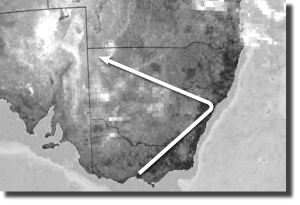
Date: May 20th, 2001
Departure: Melbourne Tullarmarine International, Australia (YMML)
Arrival: Tibooburra, Australia (YTIB)
Distance: 980 nm
They don’t seem to serve plain old coffee in Australia.
“Would you like a short black, long black, flat white, cappuccino, macchiato, caffe latte, ice coffee or a mugacino?”, the waitress at the airport restaurant asked. She was serious. I gave up and had a hot chocolate instead. It was a fairly early morning at the domestic terminal, planning the flight to Alice Springs via a flyover of Sydney—the bustling city on the east coast of Australia most often identified by the distinctive white “sails” atop the city’s famously contemporary opera house. This flight would be at low altitude for sightseeing. Because it originated and terminated in Australia, there were no international approvals or flight plan issues to contend with. Easy!
The airport wasn’t terribly busy the morning of departure, so it was only a few minutes before the Starship lurched into the air, its engines feeling peppier after servicing, even if they weren’t, actually. In less than five minutes the plane was leveling at its 9,500 foot cruising altitude for the eastern leg to Sydney before winging westward to Alice Springs. The tallest point in Australia, Mt. Kosciusko, was almost directly in the flight path, but at 7,316 feet it wouldn’t pose a problem.
Headed northeast, barely any coastal detail could be seen. While a lot of time had been spent flying over land while traversing New Zealand, the plane was headed inland in the first continental flight since beginning this adventure in San Jose seven months earlier. Australia is the smallest of the world’s formal continents, but it’s a continent nevertheless.
Historians point out that a disruptive technology every few hundred years changes the way we understand our relationship to the world around us. Most people through human history spent their entire lives tied to a single landmass. They traditionally lived and died on the continent of their birth, if not the country or even the specific region. The world was provincial, comprised of isolated communities. When sailing vessels enabled the charting of the breadth of the world, maps illustrating the immense scope of the planet were unfathomable to provincial minds. People learning of the vastness surrounding them slowly started to come to terms with their relative place in the universe. In the last handful of years, the onslaught of technological progress has shrunk the world yet again. What once was unfathomable is now accessible, and ever more so. I can fly myself to Australia, and other lands that I only imagined as a child. We can watch world events unfolding in real time on a television. The entire world is becoming the province, the isolated com-munity of old. What’s next? What next disruption will expand our sense of self and province? The more we learn of the world we live in and the space that surrounds it, the more we feel alternately cozy and terrified. It’s as if our perception of the universe we live in goes through the laundry—shrinking, expanding, and then shrinking and expanding again.
Groundspeed was lower than it should have been. Had a headwind popped up, or was it just that the air was relatively dense at this altitude, and therefore the plane was slower? An eye was kept on the instruments while looking around at the hilly area below.
Australia contains some of the oldest parts of the Earth’s crust. With the exception of the Great Dividing Range, the mountains directly below, the continent’s mountain ranges have been worn virtually flat by millennia of erosion. The Great Dividing Range was impressive; there was the occasional lake locked in the mountains, and my eye was drawn to small towns below, identified on the map with fascinating names like Wagga Wagga. It felt like home, kind of. The mountains, their greenery and their little spontaneous communities evoked California. And like California, there were scars in the forest from logging or bushfires—the sorts of things usually more apparent from the air than the ground.
Sydney eventually loomed on the horizon. It was much larger than Melbourne, and substantially more picturesque. Sydney was the first major settlement in Australia, dating back to 1788. Many say Sydney is one of the most spectacular natural harbors in the world, and its harbor was certainly just as busy as Melbourne’s. Many of the buildings had red tiled roofs. The city skyline was clustered tightly around the edge of the harbor, and sure enough, the opera house was easy to spot. There were also no problems identifying Sydney’s Bondi Beach, one of Australia’s most famous surf spots. Its rolling waves and white sand draw locals, tourists and surf enthusiasts from around the world. The FMS, programmed with the day’s route, then intersected an invisible waypoint in the sky and the Starship commenced a steep but delicate left bank, and was soon winging west. In minutes, there was nothing more to see of Sydney, not even suburbs.
Curiously, groundspeed was again less than expected. It seemed there was still a headwind, even though the plane was then headed northwest, almost 90 degrees from its original course. Could the wind have changed? Was some other factor at play? Fuel was less than it should have been for this stage of the flight. Was it better to climb higher into thinner air and hope for less wind and better fuel economy? Or stay the course? The charts and FMS showed plenty of airports on route in case. It seemed okay to stay the course, for the plane was leaving the mountains and entering the picturesque lowlands of the Australian state of New South Wales, and there was much to see.
Most of Australia’s dry continental interior is isolated from the ocean. Temperatures soar during the day, and droughts are common. The lowlands apparently receive rain; the area seemed fertile and was well farmed. It looked like a whole variety of grains were being grown. Yet across a dirty brown meandering river that snaked along across the landscape, twisting and turning and at times almost doubling back, which I took to be the Darling River, things started drying out almost immediately. There were occasional marshes. Then it started looking more like desert. There were occasional dry lakebeds with vast white patches, dried salt-like sediment. The land appeared used for grazing. Roads became fewer.
The headwind hadn’t gotten any better over the previous hour. The plane looked it would make Alice Springs with the fuel onboard, but the plan was to see Ayer’s Rock from the air before doing so, and there wasn’t enough fuel to do both. Decision time. The area had grown a lot more desolate. There weren’t many places to land in the quickly encroaching desert. A quick diversion off course could easily get the plane to an airfield near a town called Tibooburra, it appeared. How could one not want to visit a place named Tibooburra? How bad could it be?
Descending into the area, I dialed the common advisory frequency for the airport, 126.7, and announced intentions to land. No response was expected, but lo and behold, there were other planes in the traffic pattern at Tibooburra. Winds were favoring runway 20, so the Starship squeezed into the traffic and joined in to land. The plane powered down with other transient airplanes—including ancient, beat up things—directly on reddish-brown dirt. Little scrubby bushes grew around the area, tumbleweeds waiting to happen. There was little else in view. Even the tall yard lights looked lonely. On disembarking, a couple walked up from a dusty old Cessna 172.
“Well, that’s a right good looking plane! We were the ones just ahead of you. You really here from Canada?! Whatcha doing out here in Tib?!” gushed a sweaty, white-bearded, grizzled Aussie gent in an Akruba hat as wide as his smile, cargo shorts, explorer socks and ancient boots. He looked sixty-ish, and wasted no time walking right up to me to shake my hand. A plump woman who I took to be his wife, who appeared to have a least some aboriginal ancestry, stood beaming behind him.
I explained what I was doing there and they were tickled, but not completely surprised to meet a foreigner in their parts, for the town of Tibooburra is apparently famous as a travelers’ stop. But few people arrived in a big flashy plane, they said, so they were very interested in taking photos and peeking inside, and I happily obliged.
“Come into town with us,” implored the man, who introduced himself as Jack. “Let us buy you lunch, though I reckon you should be pickin’ up our tab, mate!” Sure, I thought—I’ll fill up the tanks later. No hurry. He introduced his wife as Elaine. They took me into town in their pickup, their “ute”—short for “utility vehicle”—and talked excitedly, tag-teaming in a tour guide-style narrative.
Tibooburra represented the essence of an Australian outback town, according to Elaine. It’s a fairly small town marking the midpoint between ranchland and desert, as it appeared from the air. Established at the height of the gold rush, Tibooburra (originally called “The Granites,” no doubt for the large numbers of granite boulders strewn about town) now provided services for the people of the area, as well as thousands of visitors each year. In the summer, it’s acknowledged as the hottest town in the state. The Australian National Parks and Wildlife Service has an office there, as does the New South Wales state police. Jack was proud that Tibooburra was sort of known of as the most remote town in New South Wales. He admitted it’s occasionally the butt of jokes in Australia. For instance, a Sydney radio show once offered people a weekend stay in Tibooburra as a kind of booby prize. I empathized immediately, for I spent a few years in my teens in a town in Canada called Wawa, similarly famous for the same reason. (Wow, I reflected; Canada sure felt a long way from there.)
We crossed a cattle grate, passed a sign announcing Tibooburra, population 150, and were in town. Like Invercargill in New Zealand, the streets were unusually wide, and the red tinge of the dirt was remarkable. Unlike Invercargill, most buildings were one-storey. It was all quite flat. Jack parked outside the Family Hotel, one of two in town. Venturing inside, it was hard not to notice the murals of nude men and women, many of them in suggestive postures. The murals were originals, though yellowed by age and cigarette smoke. They were in a confident impressionistic style, and it was clear they were the work of an accomplished artist. The last thing I expected to find in a remote town in the middle of Australia were world class paintings.
“Clifton Pugh,” said the man behind the bar.
“I’m sorry? What was your name?”
“Clifton Pugh. Famous Australian artist. That’s who did what you’re looking at. My name’s Peter the Wog.”
“I see.”
A sheep materialized from behind the bar and came up and put his head on my knee as we sat down.
“Now there’s a real Tib welcome for ya! Where else would ya get that, ha!” proudly exclaimed Jack. The sheep looked up lovingly.
The original plan was to return to the plane later in the day and continue on. But Jack and Elaine would hear none of it, and plied me good-naturedly with alcohol all afternoon to ensure I wouldn’t be fit to fly. They were proud of their town, and thought it’d only be fitting for me to spend some time to see the sights. I couldn’t help but accept. I wasn’t exactly on a timetable. I’d never have guessed, then and there, that the stay would be a month.
They told the story of famous Australian explorer Captain Charles Sturt and his expedition, who ventured into the area south of Tibooburra in the summer of 1845 carrying a boat searching for an inland sea. The area was in severe drought and incomprehensibly hot. For several months the group camped beside a water hole in an area now known as Depot Glen. The men were dying of scurvy. By the time rains finally came in July, Sturt’s second-in-command took ill and died just as they were preparing to finally leave to continue their quest. His body is buried beneath a beefwood tree not far from their campsite at Depot Glen, now accessible by the public.
Another attraction popular with tourists was “the great dingo fence.” This actual fence, part of which is near Tibooburra, runs along parts of the border between states and is now intended to keep wild dogs, dingos, and other critters out of the sheep ranches of New South Wales. The fine for leaving a gate open is $1,000 Aussie dollars. They say Australia’s dog fence is the longest continuous fence in the world, 5,600 kilometers long. It was originally built in the 1880s to keep rabbits out, and was a dismal failure.
It became apparent that Jack and Elaine were the real thing, genuinely good natured and well-meaning folks. We laughed a lot over lunch. They wouldn’t let me pick up the tab, drove me to the plane to pick up my things, drove me back and even insisted on sticking around to make sure I was able to arrange a room, which turned out to be a great little cabin across the street from the hotel.
While grocery shopping the next day, the town’s mining heritage came up with Wayne and Caroline, owners of the local store. They pointed out there were great old abandoned gold mining facilities south of town near a village called Milparinka that might make for good adventuring. It so happened that Wayne, who moonlighted as a truck driver, was headed that way later in the day, so I loaded my backpack and grabbed some warm clothes.
The beautiful courthouse and police barracks in Milparinka were impressive. At the same time, decaying sandstone foundations elsewhere in town suggested one-time prosperity, with buildings and families now long gone. The gold rush, there as elsewhere, just didn’t sustain.
With a couple of days of water and provisions, I set out on foot south of town to Mount Browne, the area Wayne had recommended. The dusty road snaked through a dry riverbed. There were a number of stops to take in impressive desert vistas, as they were so different from the rocky boulder-strewn countryside of Tibooburra. At a couple of spots, the road came up out of the river up onto the river flats. On one large flat there finally appeared the remains of gold mines, numerous mullock heaps and a number of one hundred-foot shafts, shored up with timber, absolutely alone and in the middle of nowhere. The temptation to venture inside was overwhelming.
Further along, by the river, was the remains of an old mill. Another delightful setting and an ideal spot for lunch. The area was littered with smashed bottles and old crockery, plus all kinds of well-rusted machinery. Down the dry river were the remains of what must have been one of the hubs of the gold industry in this area. There were all kinds of devices I couldn’t recognize or name, let alone fancy a function for. There was what looked like an immense boiler, and a heap of other assorted bits and pieces of machinery. It was difficult to visualize what must have gone on back then in the 1880s, only a hundred and twenty years earlier. A broken windmill and cement water tank suggested the area might have still been in use in more modern times, though probably only to provide water for livestock. I pitched my tent to stay the night.
Over a fire late in the evening, the sky was so desperately black and the stars so clear there that the swath of the Milky Way galaxy was easily visible. The big dipper is hard to see in Australia, but the Southern Cross is truly magnificent. Stars winked. Satellites arced. Meteors flashed silently across the sky. The occasional plane swept by, high and silent. It was hideously romantic, and all the ancient mining machines around lent the scene an odd kind of grotesque eroticism. In the animation of the firelight, these rusting structures seem to cavort and contort in bizarre slow rituals, like they were dying, or mating. And they were doing it clandestinely; I could only catch them out of the corner of my eye, for if I looked at them directly, they’d stop. It was wonderfully creepy, anthropomorphizing these things against the bright starry sky, and I had great fun scaring myself to sleep. It was hard to tell if it was this unreasonable visceral fear making me shiver, or the cold from the onset of the Australian winter.
Thinking of the starry night while walking back the next day, I considered that most people likely don’t look up into the sky nearly enough. We’re usually so preoccupied with what happens terrestrially that we forget to gaze up above in our daily lives. That’s not looking to the heavens as a metaphor for reflection or inspiration—but literally, most people don’t physically look up enough! I get a kick out of standing on bridges or rooftops, looking down at people, and making eye contact with the rare person who chances to look up. I’ve always wondered at the vastness above. Clouds have always seemed among the true, democratic aesthetic treasures of the world. Anyone, anywhere can enjoy the beauty of a thunderhead, say, and watch it slowly bulge up on a summer afternoon. The shifting gradients of light as they permute over time in a morning sky are stunning. Yet how many people are up early enough, or have enough time to properly watch and appreciate a sunrise? Or the lazy pleasure of a bird hunting, circling high above? A huge variety of phenomenon play daily in the theater above our heads. There’s so much to see, but how many of us take time to lie on their backs and look into the heavens? Few gaze into them. Still fewer explore them.
The sky wasn’t calling yet, however. Back in Tibooburra after hitching a ride with the mail driver, locals suggested checking out Sturt National Park, home to the lanky “big reds,” kangaroos that stand nearly two meters tall. Check. I finally returned to town and once again set up in one of the cabins across from the Family Hotel. Jack and Elaine came out drinking now and then, and helped the others teach classic Australian pub songs. I likely stayed as long as I did in Tibooburra largely on the basis of the fun we had singing those songs! It’ll be a long time before I’ll forget Who Put the Roo in the Stew, A Pub With No Beer (said to be based on an actual incident), Click Go The Shears, My Boomerang Won’t Come Back, The Day I Rode the Emu and Tie Me Kangaroo Down. My personal favorites were Duncan (in which you can substitute your own friends’ names for fun) and Home Among The Gum Trees (complete with actions).
A few “mates” were made in Tibooburra, most from unexpected circles. A better friend ended up being Jerry, a young, fast-talking cattleman of part aboriginal descent who’d actually started medical school in Brisbane but apparently ran out of money. He was jovial and quick, not quite as laconic as most folks in town and very interested in North America. Many of his mates from school had traveled and seen a lot of the world, but he hadn’t the money. He was currently working on a cattle station—Australian for ranch—near town, to try to save enough money to return to medical school. Jerry was fascinated by my trip, and not so much jealous as genuinely happy to be able to share my experiences and hear inside scoop about America. One night, I told him one of my favorite horror stories about dating in Silicon Valley. We were on the verandah of the Family Hotel, drinks in hand, Jerry puffing on a “rolly,” a hand-rolled cigarette.
“So on our third date, this girl asked directly how much stock I held, my company’s valuation and number of shares outstanding. She did the numbers in her head, and told me at the end of the night she didn’t want to see me any more. Flat out told me to my face that another guy she was dating was more ‘fiscally desirable’.”
“No way!” He snarled. The Bundaberg rum he was drinking made his face ugly in disbelief.
“Way,” I responded. “True story. But I got the last laugh. My company went public before his did. Opening day, our stock shot through the roof and kept going, even through the holding period. His tanked three months after IPO. I sold everything I’d vested and bailed. He got virtually nothing.”
“Bad call for her.”
“I don’t date California women anymore,” I said.
We toured the plane one cold afternoon. “Too bad you weren’t here in September, mate,” Jerry said, grinning like a kid. “They hold these horse races in this town northwest of here called Birdsville every September, and it’s something you just have to see to believe. But it’s not like snooty horse races. Thousands of people all bring their tents and set up this big tent city. People fly in from all over Australia. Hundreds of planes. Lots of ‘em fuel up here at Tib and buy fuel from Peter the Wog, or sometimes they’ll land here if there’s bad weather in Birdsville. The Birdsville race is a big weeklong bush party!” Australians, I’d learned, as in Canada, tend call the great out-doors “the bush” regardless if there’s scrub or trees actually around. A uniquely British colonial euphemism.
“Really?” I asked. “And do they all drink like you guys do in this town?”
“Oh, way worse.”
“Then maybe it’s a good thing it’s not September right now. I’d never be sober enough to fly this crate outta here.”
The farther out from any major center, it seemed the less there was to do but drink.
Spending so much time at the pub gave ample opportunity to note Australian toilet design. Much like in many areas of the U.K., the toilets in Oz have two flush options: a half flush for small jobs and a full flush for bigger ones. A small flush takes 2-3 liters of water, a large 4-6 liters. When the vast majority of your country is hard-to-irrigate desert, you take water conservation seriously.
By then, the Australian winter was pretty well in full swing and the days were quite short. I’d seen, done and drank as much as there was to in Tibooburra. The dingo fence had been done. The boulders in and around town had been scrabbled over. The School of the Air was toured, an impressive setup where kids in town share a virtual classroom with kids in remote areas live over VHF radio.
Early one Friday afternoon Jerry drove me and my things to the airport. I’d said goodbye the night before to all my new friends in Tib, and had sworn off the drink in light of the flight. Jack and Elaine also came by the airport bright and early for the send-off. The three dawdled around during the pre-flight walkaround. Peter the Wog had been paid for fuel the day before. Fellow pilot Jack helped verify the weight and balance calculations and happily double-checked the performance chart reference that confirmed the plane would be able to lift off Tibooburra’s shorter-than-usual runway in the morning heat. Then it was time to go.
“A pleasure, mate. Remember us, ‘kay?” Jerry was a little choked up. So was I. They all said they’d stick around to watch the takeoff, so after trading contact information, I closed the door and turned to the checklists. There wasn’t a ground controller or air traffic controller to contend with, so it was a simple taxi to the edge of the runway to perform the pre-takeoff engine tests. All seemed okay. The area was checked carefully for landing aircraft, position taken, the takeoff announced on frequency and the power levers eased forward. There was one last glance and quick wave to the three of them standing to the side of the runway as the plane barreled by, and from the corner of my eye, it was possible to vaguely make out that they were waving, too. And then, just about to run out of runway, a gentle tug on the yoke at rotation speed and the Starship lurched into the air at its impossibly steep climb angle. In seconds, the plane was so high it was hard to even discern that there were people down there to see. There was only desert, and the outline of an impossibly long fence stretching out to infinity.
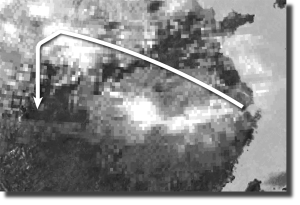
Date: October 22nd, 2001
Departure: Hongqiao airport, Shanghai, China (ZSSS)
Arrival: Shuangliu airport, Chengdu, China (ZUUU)
Distance: 1377 nm
Travel planning indeed got a lot more complicated. The U.S. started its air bombardment of Afghanistan. Neighboring countries like Pakistan, Iran, Kazakhstan and Uzbekistan suddenly appeared to be a lot less safe. Even factions within Pakistan, a sometimes U.S. ally, had been rallying and assassinating occasional westerners in protest, even though the country’s government had reluctantly agreed to this particular invasion of Afghanistan. Recent anti-American rioting in Nigeria had left hundreds dead, according to the news. The post-9/11 emotions and rhetoric that were starting to come into their own a month after the attacks weren’t just redrawing geopolitical lines, they were also contributing to further loss of life.
I feared a racial backlash against Anglo-Saxons, myself included, if I strayed too far into central Asia. There was no telling how far my Canadian flags would protect me. Local media had been criticizing the U.S. for the hundreds of racial attacks certain of its citizens had been carrying out in the last few weeks against Arabs, Muslims, Indians and others who looked even vaguely Eastern.
Not long after arriving in Shanghai, a Russian passenger plane was shot down over the Black Sea, where the Ukraine, Russia and Turkey converge. It was too early to know for sure, but a Ukrainian military exercise seemed to have been responsible. I’d actually considered stopping in the Ukraine, the land of my ancestry, this trip, but reconsidered. The downing of the plane suggested that despite official denials, itchy trigger fingers were far and wide.
Everyone, everywhere, was apprehensive. What was happening in the world? Everything had changed so quickly.
I began to wonder about the viability of the flight, of the wisdom of continuing. In the month it seemed it would take to negotiate with authorities for permission to fly over the Chinese mainland, there was plenty of time to buy and study aviation maps of the country, to think hard about what I was doing and whether to go on.
Then people in the U.S. started dying from anthrax. The U.S. media whipped itself into a lather and sent everyone to bed every night worrying about white powder in their mail, poison in their water and chemicals dispersed by crop dusters. Unfortunately, at the time, it was hard to tell whether these were genuine threats. Was this really time to head back? Was it possibly safer where I was? Was this really the same world I remembered from only a short month or so ago?
I eventually decided to press my luck and venture farther into China and then northwards into Russia, though it would inevitably bring the plane closer to Pakistan and Afghanistan on the way. The rationale: I was already there, and for now it seemed safe. With a wide enough swath around the Persian Gulf, things might be fine, I thought optimistically.
Then there was friendly fire to worry about. While concern about hostiles was one thing, it would be bad to attract the attention of allied warplanes buzzing in and about Afghanistan and Pakistan. The unconventional lines of the Starship might even confuse a vengeful American fighter pilot. Now, there’d be the makings of a tragedy.
China, the world’s most populous nation, has a vast, unbroken cultural history, longer than that of any other country. But only recently has it begun to emerge as a leading world power. Before China’s renowned Chairman Mao established communist rule in 1949, the country had become something of a backward feudal empire, stricken by civil war and more than a century of European and Japanese incursions. The closed regime withstood the traumas of rapid industrialization, communal farming and the brutal purges of a now-infamous Cultural Revolution. Starting in the 1980s, Deng Xiao Ping, Mao’s successor, introduced economic reforms led by expanded foreign trade and privatization of once state-owned industries, and trumpeted the phrase “to get rich is glorious.” The reforms, a 180-degree turn from the communal path Mao forged, were dubbed special Chinese communism—in other words, thinly-veiled capitalism.
China’s population is concentrated along the coastal provinces of the south and east, although the most populous region is still close to the fertile planes in the Chinese Midwest. Despite accelerating urban growth, China remains predominantly rural. One cultural group, the Han, make up over 90% of the people. Other main ethnic minorities are scattered in pockets around the country, with concentrations in “autonomous regions” in the south and west.
There are several major Chinese dialects, and many sub-dialects. The Beijing dialect, often called Mandarin, or Putonghua, is taught in all schools, and almost two-thirds of the Han consider it their native language. The rest, concentrated mostly in the southwest and south-east, speak other dialects.
About 90% of China is unsuitable for cultivation, being either climactically or topographically diverse or lacking sufficiently fertile soils. Most of the west is used for nomadic herding, while farmland is concentrated in the eastern monsoon region, with rice grown in the tropical and subtropical south.
Some say today’s Shanghai, translated literally as “city on the sea,” represents an even more exciting vision of the future and fusion of east/west culture and technology than does Tokyo. Thousands of years of rich Chinese tradition are still fully alive and well in the giant metropolis of Shanghai, despite a downtown skyline now remarkably reminiscent of New York. The faded glamour of Shanghai’s colonial past—quick riches, ill-gotten gains, fortunes lost on the tumble of dice, swindlers, gamblers, opium dens, drug runners, dandies, tycoons, missionaries, gangsters and huge brothels—seems to be morphing in real-time into China’s dreams for the future. Some say it’s the world’s fastest-changing city: blink, and it becomes something different. Nothing is totally sacred; even grand old bank buildings on the city’s most famous boulevard, the magnificent Bund, are under renovation, being readied for clients like JP Morgan and Hong Kong Shanghai Bank, which fled in 1949 after the communist takeover.
Foreign and domestic investment in the city has relit its flame. New money has led to new cultural institutions, karaoke clubs, cell phones, health clubs—even a thriving gay bar district. Downsides exist: prostitution and street crime have increased, as has drug use and AIDS. In other words, Shanghai now sports many of the ills of any other normal great city.
Even ten years ago, city fathers likely couldn’t have even begun to fathom western-style nightclubs, especially hopping ones like Shanghai’s now-popular New York, New York. Stumbling brazenly out of this particular hotspot one night at five in the morning, having fooled ourselves into thinking we’d been in just any another American dance club, I and a few fellow European revelers rounded a corner and suddenly interrupted the sights and smells of a wholly unique Chinese tableau: groups of round-faced Han Chinese huddled in small, dark stalls on the street wolfing down pungent food we didn’t recognize. Traditional music lilted from unseen tinny radios. Broad, illuminated signs bore exotic and unfathomable characters. Laundry draped from balconies. It was an unusually poor little enclave. We hustled away, embarrassed. Minutes later, we came across a small lake nestled in the heart of the city. On its shores, lit by the dawn, hundreds of Chinese were in the throes of morning Tai Chi. We watched silently, captivated.
Many Chinese are proud of their cultural progress, and tried to engage me and other foreigners to assert and validate their ‘westernness.’ Students, for instance, often tried to practice their English, which, as expected, led to more than a few stilted conversations. Some wanted to show off their artwork. One particularly toothy and persistent kid insisted on listening to him play the guitar. When I politely declined, he cheekily wanted to know where I was staying and when I would be leaving, seemingly convinced an audience with me could put him on the road to American stardom.
Food in China was difficult at first. Restaurants ranged from massive, modern four-level places with hundreds of tables to noodle shacks on the street. There were usually no decipherable menus, just tables of vegetables and tanks full of fish, shellfish and snakes, even a shark at one place. Ten minutes after pointing at a fish, it was on the table. Chicken, duck and pork dishes were also displayed on tables.
I tried more ambitious dishes with local friends. For instance, ‘drunken shrimp’ turned out to not be just a colorful euphuism for one particular dish, but a literal aphorism. These unfortunate shrimp are literally marinated live in some kind of alcoholic sauce. They come to the table, still thrashing around—like us on the dance floor at New York, New York on vodka Red Bulls. You have to wait until they die, essentially, or otherwise they can give you a nasty nip on the lips, as happened to our Australian friend Brett.
Then there was the egg incident. We were at a bar having a few beers when some acquaintances brought in a bag of food, including what looked like fried pigeon and eggs. We’d all had a few Tsingtaos, and seeing as there were no kebabs or chili cheese dogs around, I thought I’d try some. The pigeon was quite good. I picked up an egg and shelled it. It tasted and felt a bit strange, but everyone else was eating them, so I picked up another, started to shell it, and then nearly threw up. Inside was a fully formed chick, with feathers, eyes and everything, seemingly asleep. I dropped it in fright and repulsion, but someone picked it up and ate it.
Brett had told stories of certain Chinese thugs he knew, and I wondered whether we’d meet any. One night, he introduced us to Mr. Big, a aptly-named thick, towering fellow. The man couldn’t speak a word of English, but he liked us, and we didn’t dare not like him. We accompanied Mr. Big to the back room of some uniquely seedy club, and it was like a scene out of a Chinese Goodfellas—space was immediately made for us; waiters hovered obsequiously; there was dancing and singing on stage, but the show actually stopped so Mr. Big could do a spot of karaoke.
The next thing I knew, I ended up sandwiched in a taxi somehow with Mr. Big and two almost as large bodyguards, while Brett and a few of the others went in another car. Everyone in my car was jabbering away in Mandarin and smoking like maniacs. The car drove and drove. They continued to banter incomprehensibly while smiling and pointing enthusiastically at things out the window for my benefit. We finally disembarked at a stinking alley in some unknown quarter of the city. Shadowy characters lurked here and there. As we entered a little shack, I wondered how I could politely extricate myself without knowing a word of Mandarin when, thankfully, there were Brett and my other comrades playing cards with a cadre of Mr. Big’s goons. Lots of beer and food and a strong, repugnant sorghum liquor called Wu Liang Ye was forced upon us, with plenty of toasting, smoking and laughing. These boys could party.
I had no idea what was going on, and there was no point worrying about it, so I just drank when prompted, ate whatever mysterious thing was placed in front of me and wondered if I’d still be wearing clean underwear when the Canadian Embassy eventually managed to fly my body home. Yet as imposing as they appeared, everyone remained friendly and generous. I never once really felt threatened. When we eventually surfaced at another bar towards the early morning hours, I was beyond concerns about making it home safely. After all, who would even think about messing with our posse?
I flew out at 11:20 in the morning on October 22nd on the first day of reasonable weather in a long while. There’d been a big system over the area, and while it looked like it’d cleared through the center of the country, it was forecasted to cloud over again heading south to my destination of Chengdu, China’s gateway to the vast Himalayas of the Tibetan plateau, the highest mountains in the world. But that wasn’t to be the destination quite straight away.
While it’s a common misconception that The Great Wall of China can be seen from space, it seemed there’d be a good chance of seeing it from 33,000 feet if I could only get in the vicinity. So I badgered authorities to let me fly in the area, admittedly kind of out of the way to the north, before heading to Chengdu and ultimately west out of the country into Russia. After a month of trying to assuage the Chinese officials’ concerns, sometimes involving gifts of cigarettes and sorghum liquor up the chain of command, papers eventually came that granted permission for a very specific route of flight at very specific high-level altitudes: direct to the vicinity of the middle section of the Great Wall in the vicinity of Xining, capital of northwest China’s Qinghai province, and then back south to Chengdu. The plane was also cleared for other points westward. No deviations would be tolerated, came the warnings, likely because China’s army missile research station, nuclear weapons research station and space research facilities were all in the vicinity.
There were more than a few reasons for the Chinese to be edgy about U.S. planes. Earlier in the year, while I’d been basking on the beaches of Fiji, a Chinese fighter collided with a U.S. spy plane while apparently harassing it, according to the American account. The Chinese pilot ejected and lost his aircraft. The U.S. plane was forced to land on a Chinese island. The incident sparked a months-long diplomatic row.
On departure, the plane was routed out over Shanghai proper to the south, and then brought back to head northwards on course. Gentle chop kept things interesting on the climb to cruise. The Starship flitted in and out of stratus in the area, and finally entered a delicate, hazy white mist about twenty minutes out of Shanghai. The silky whiteness reached all the way up to cruising altitude at flight level 330.
While there was nothing to see, it was still exciting to be back in the air again after a month cajoling the Chinese bureaucracy for clearance while watching political passions rage around the world. Up there, things were so much simpler. The engines were true and strong. No, there was nothing to observe save the indistinct snow-white luminescence, but the familiar thrill of being in transit again was exhilarating. I kicked back and relished being right there then, in this white room, impossibly high up over the other side of the world.
Flying, especially when socked in by whiteness, is a sort of literal manifestation of a Zen state. If one aspires to true integration with the world, to full connectedness and ceasing to exist as a discrete entity, flying is a step in that direction. In flight, you don’t exist anywhere in the everyday world, and are even forcibly prevented from participating in it. You’re suspended in a sort of negative space when you board a plane, a metaphysical halfway state. From the perspective of those on the ground, you’re suddenly nowhere—you cease to exist! Yet as you flash across the landscape at impossible speeds, you’re indeed everywhere at once. You become your surroundings as you whiz through them, folding yourself in and around them.
Seen in another sense, although the airplane sustains the body, it’s really the mind that makes the journey. The body steps on the aircraft and eventually steps off, but the journey in between is virtually all mental. You don’t do much physically in the cockpit; you sit, make a bunch of calculations, twist some dials and knobs, and when you leave the plane you’re back on Earth. Maybe, if the weather is clear, you gaze down on views that no human before this century could ever have had a chance to see. Or maybe you spend most of the time daydreaming or otherwise preoccupied with thoughts that come miles in the sky. The airplane may physically transport you, but it’s the mind that conducts the journey. Flight, even mechanical flight, is the genuine disembodiment.
When the ground became visible again, there were only flat, patchwork green fields below and scores of towns and villages. It was the Yellow River basin, and this was major farmland, no mistake. The growing season must have been longer than North America’s, for there still seemed to be crops in the fields. It was hard to tell for sure from so high up, but the area was famous for its wheat, millet, sorghum and cotton. As pastoral as it looked, it was a treacherous area to live in. This was the upper part of China’s most famous flood plain—where scores of people had died over the centuries from the unpredictable Yellow River. As time went on and the plane left the area, the greenery transformed to arid plains, which in turn became largely rolling rock, punctuated only occasionally by greenery. It started to look less and less hospitable. The ground eventually assumed an odd yellow-brown color that was uncharacteristic of anywhere else previously seen on this adventure. It was loess, I later read, a loose soil made up of wind-blown material. Translucent clouds whisped by, transforming the blasted landscapes below into ghostly, craggy tableaus.
Then, near the city of Lanzhou, not far from Xining, stretched the rolling serratedness of the Great Wall. The wall is still properly characterized as one of the great wonders of the world, as it represents an engineering feat that’s rarely been matched in the 22 centuries since its construction began. Stretching 4,500 miles, from the mountains of Korea to the western extent of the Gobi Desert that covers the center of China, it was actually a series of walls built and reconstituted by different dynasties over 1,000 years. They were all constructed out of the same motivation—protection from marauding tribes from the north. The Great Wall remains an emblem of China’s ingenuity and will. From altitude, it appeared as a low, thick line that twisted around on an impossibly crazy route. Sporadic clouds got in the way before long. Then the next waypoint kicked in, and the Starship swung itself around south.
The long flight south to Chengdu over the dark brown rolling Bayan Har Shan mountains gave plenty of time for reflection on time and distance. A tailwind had kicked in, propelling the plane faster and more fuel-efficiently than before. If this flight felt it was taking long in such a fast, futuristic airplane, how did people traverse such distances through terrain this intimidating hundreds of years ago? Chairman Mao’s Long March retreat of 1934 went through this area, a hundred thousand men and 35 women. It would have been a huge physical effort to guide pack animals through the extremes of elevation, temperature and humidity just underneath the plane. This journey that was taking me only hours could very well have taken months, if not longer, only a hundred years ago. Some people in remote mountain areas of China like this still travel by mule caravan. Tibetans walk and bring yaks. Others use camels.
The controller cleared the plane for a slow descent towards Chengdu. There were a few cloud layers to penetrate before the ground could be properly distinguished. Eventually passing 16,000 feet, the plane dropped out of a thick gray bank of cloud to rain batting the windows. Visibility was poor, but what looked like an oncoming mountain ridge could be made out, looking dangerously higher than it should. I requested a higher altitude, but was told by the controller to maintain the current descent and heading. Pilots aren’t bound to adhere to controllers’ directives if their safety is in danger, so I kept my hands on the controls to intervene if necessary. Yet sure enough, the Starship whizzed over the ridge with what looked like a thousand feet to spare.
It was only about 4 in the afternoon, but the sun sets sooner in the mountains. It would be a dark landing where Chengdu lay at the foot of the Himalayas.
The slow 1,000-foot-per-minute descent rate kept the plane skimming the underbelly of the clouds, which also seemed to be inexplicably descending closer to the airport. In mountain valleys, low cloud was also beginning to settle, forming a creepy dark brown wonderland off to each side. The ATIS weather report broadcast by Chengdu’s Shuangliu airport said to expect overcast clouds at 6,000 feet and scattered clouds at 3,400. Runway 2 was in use. So the landing wouldn’t just be dark, it’d likely be rainy.
Then, there: a first view of the snow-capped peaks of the Himalayas. There’d been lots of white mountaintops to see scuttling in and about California’s Sierras in my Piper Arrow, but here, a world away, were now the regal Himalayas I’d only heard tell of. Their tops poked out above a white baby blanket of cloud.
Rain spattered the windshield. Everything was darker now, but appeared wet and fresh. Chengdu itself then appeared. Lights were starting to come on across the city. The airport to the left, exactly where it should have been, was splendidly lit. The rain streaked across the left and right windows as I looked around at the dark world unfolding around. The drops appeared as streaks, illuminated by the cabin lights and the strobes outside.
The controllers set the Starship up well for landing, and it was nicely established four miles out on final approach when the tower cleared the plane as “number two” to land behind traffic that was just then touching down. The plane nuzzled down to the wet pavement. With the prop reversers working as they should, it was an easy taxi off by the runway midpoint.
The darkness continued to thicken as the plane shut down in the rain. The mountains to the west ascended into clouds turned lavender and mauve by the dwindling light.
The evening meal was at a sidewalk hot pot, a quintessentially Chengdu phenomenon. I’d heard about these. Surrounding central heating elements, bubbling rings of boiling water simmered, into which diners dip a variety of foods, including thinly-sliced cow tongue and liver. There were rumblings afoot that a new mayoral candidate was promising to crack down on outdoor food vendors, confided the roadway restaurateur in good English, but for now our dinner was still legal. I sat in the midst of mostly Han Chinese there on the sidewalk, out of the rain under a tall, red fabric banner with undecipherable calligraphic characters.
A young, ill-shaven man sat down, curling what looked like road-weary feet beneath him. He looked Indian, maybe Pakistani, and was initially reluctant to talk with me. But on learning I was from Canada, his disposition changed. He lit up.
“My brother’s in Canada!” he beamed. “Toronto!” He and his family apparently lived in Toronto’s Little India district, only a few blocks from a home I’d almost bought back in the early ‘90s. We chuckled at the happenstance.
“I’m PK. I’m sorry. I thought you were American,” he admitted.
I almost let this go. “And what’s wrong with being American?!” I challenged, playfully. He looked at me carefully with wrinkled brow, and took a gamble.
“Well, nothing. After all, they’re the chosen ones, right?!” he parried darkly. “I’m sorry, no any disrespect to any American friends, but it’s unfortunate that it took an event like what happened in New York for America to finally wake up to the fact there’s a bigger world out beyond its shores.”
“Oh?”
“Well, for years,” he continued, “America has been painting a big target on itself. Look at its fifty-year history of destabilizing governments, flaunting international law and playing the world’s bully. It’s hardly a well-behaved global citizen. It places troops in countries around the world, whether they’re wanted or not. This conflict is being painted as Muslims vs. the United States, but it’s bigger than that. There are whole big swaths of the world that are more and more unhappy with what the U.S. has been doing.” He continued, citing specifics like the ongoing U.S. history of destabilization in Central America and the arming of Afghan rebels to help oust the Russians. Walking away from weapons reduction treaties. Resisting global warming treaties. The indictments went on and on. PK had been to university in Karachi, and clearly hadn’t shirked his homework.
“Sure, but America still does a lot of good in the world,” I countered.
He looked into the hot pot and stirred it absently. “Americans think they invented freedom. They trot it out as their biggest contribution to the world whenever they’re criticized. ‘Yes, we do bad things, but for freedom! Democracy! Elect your leaders, or you’re heathens!’ Do they ever pause and consider whether American-style democracy, not to mention its movies, music and fast food, are wanted elsewhere in the world?!” He looked at me. “For years the Americans have been slowly dominating the world through espionage, outright wars and their infectious cultural viruses. Maybe the world has had enough.”
Up to now, I’d heard only empathy for America and the losses it suffered the month before. There hadn’t been much overt criticism like this. These were strong words. But then, the Afghanistan flashpoint was getting closer and closer.
We talked further. Most Chinese sitting around appeared to be paying us no attention. PK went on to theorize that the current bombing of Afghanistan was going to further jeopardize the security of the United States. That by trying to bomb supposed adversaries into submission, the U.S. was actually playing into the hands of critics and evidencing one of the primary reasons others were angry at it.
“They should address the root causes of why they’re disliked, and not the symptoms like terrorism,” he said. “Nineteenth-century surgeons clumsily hacked off limbs to treat minor maladies. Has nobody learned anything since then? If this keeps up, things are going to get worse before they get better.”
Some English-speaking Chinese around us joined the conversation, so we all ended up sitting together, talking and eating. It turns out the local Chinese distrust of foreigners started a long time ago, and came to a head in the early 1990s when archaeological raids by “foreign devils” from Britain, France, Germany, Russia and the United States removed whole libraries of ancient manuscripts, frescoes, and relics of early Buddhist culture from Northwest China, including the oldest known printed book in the world. How would the West feel if it were plundered by the East today, they asked?
Because the plane had come substantially west earlier in the day, my companions outlasted me. I excused myself when I started nodding off on the sidewalk. There was plenty to think about while drifting off to sleep at the hotel.
One thought in particular kept banging around: Was it possible that, in the same way flying and diving helped acquaint people with other physical parts of the world they didn’t necessarily know previously, that contrarian points of view were now more important than ever to explore so as to build a larger understanding of the dynamics of the world? Whole other perspectives, modes of thinking and realms of possibilities no less legitimate could be found in other cultures. Who knew what important lessons America might benefit from, it seemed, if it started doing a better job of listening to and drawing on the worlds of experience and disciplines of Asia and elsewhere.

Dallas Kachan has served as vice president of sales and marketing for several high tech startups. He helped popularize renewable energy and other clean technology worldwide as one of the managing directors of the Cleantech Group, based in San Francisco. Prior to his technology career, Kachan had been a reporter, editor and newscaster for the Canadian Press in Toronto, Canada.
Kachan has a B.A.A. from Ryerson University in Toronto, Canada and lives in and flies out of the San Francisco Bay Area. He’s been flying since 1994—and had been an avid flight simulation enthusiast long before that.

$5.48
$17.47
$25